
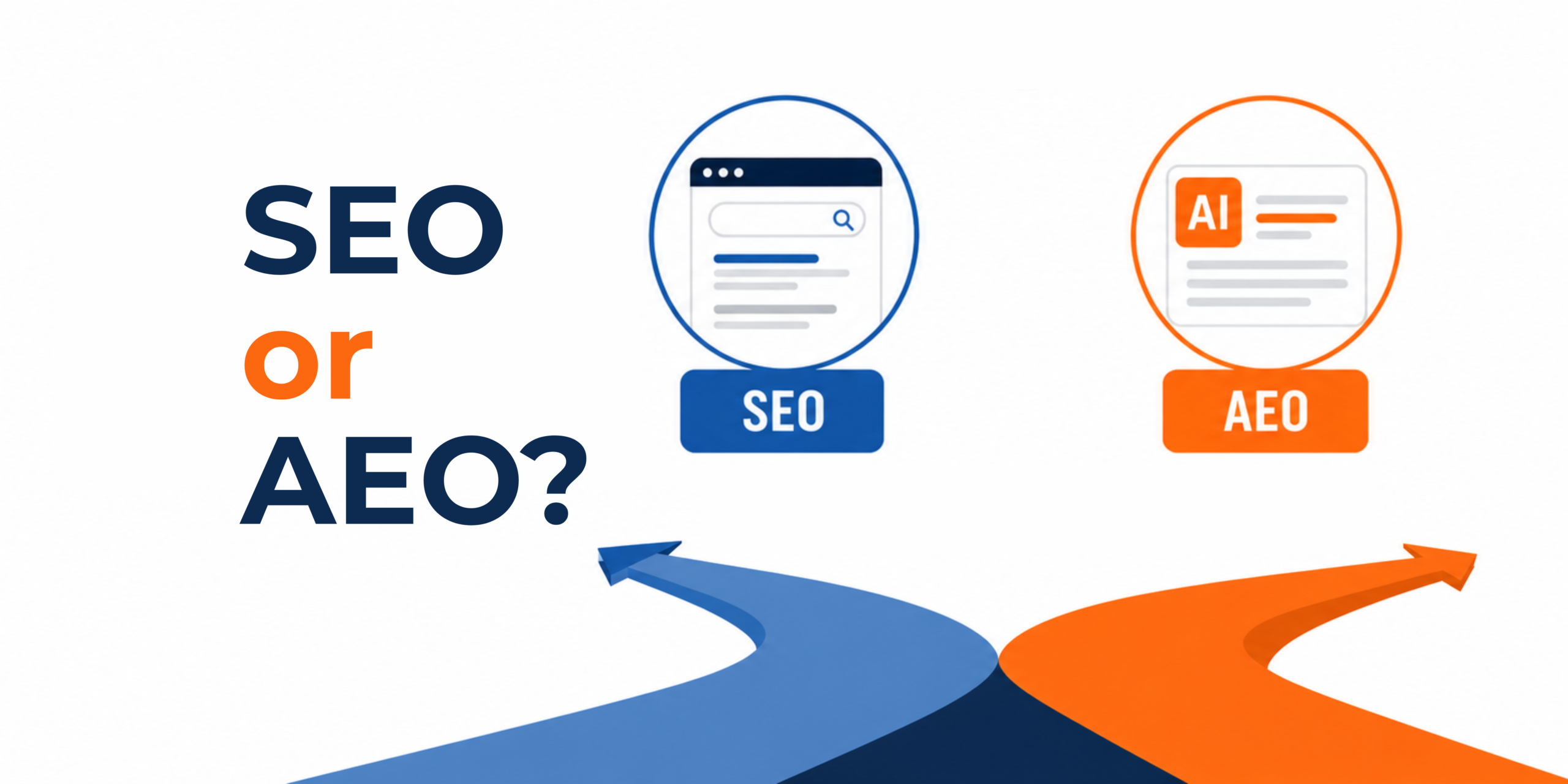
For years, businesses have invested heavily in Search Engine Optimization (SEO) to improve visibility, drive website traffic, and generate leads. Their focus is on ranking higher in Google, attracting more visitors, and converting those visitors into customers.
But search is changing. AI has entered the chat. People are increasingly turning to AI-powered tools like ChatGPT, Google AI Overviews, Microsoft Copilot, and voice assistants to get quick answers instead of scrolling through pages of search results. As a result, a new strategy was born: Answer Engine Optimization (AEO). Rather than focusing solely on helping your website rank, AEO aims to help your content become the answer.
So, what does that mean for SEO? Is AEO replacing it, or simply changing the way businesses need to think about online visibility?
Let’s Start Here: What Is Answer Engine Optimization (AEO)?
Answer Engine Optimization is the practice of creating content that's easy for AI-powered search tools to understand, summarize, and display to users.
Instead of optimizing for keywords and search rankings, AEO emphasizes:
-
-
- Clear, direct answers
- Conversational language
- Well-structured content
-
This is a shift in how people search for information. Users increasingly expect immediate answers without having to click through multiple websites or webpages.
The Biggest Change: Users Don't Always Need Your Website Anymore
Traditional SEO followed a simple path: a customer searched for information, clicked a link to a website, explored the content, and hopefully became a lead.
AI has changed that journey. Today, someone can ask an AI assistant a question and receive a complete summary without ever visiting the website that provided the information. This is often called zero-click search, and it's becoming more common every day.
For businesses, that creates a challenge. Your expertise may be helping answer thousands of questions online, but if those users never visit your website, how do you build relationships, generate leads, or measure success?
Why Some Marketers Are Concerned
Organic Traffic May Decline
For many organizations, organic search traffic is a significant source of leads and revenue. When AI answers questions directly, fewer people need to click through to blog articles, knowledge bases, or service pages. Even if your content is being used, your website may see fewer visitors.
That doesn't mean your content has lost value; it simply means the path to your website is changing.
Content Is Becoming Increasingly Similar
SEO rewards businesses that demonstrate expertise and publish thoughtful, in-depth content. AEO often favors content that's concise, structured, and easy for AI to summarize.
As a result, there's a risk that content becomes increasingly generic. Instead of offering unique insights, many articles begin to sound alike because they're written for algorithms rather than people.
Visibility Doesn't Always Build Your Brand
Previously, appearing on the first page of Google meant users saw your company name, your website, and your brand.
AI-generated answers don’t work that way. They summarize information from multiple sources or paraphrase your expertise without users ever interacting directly with your business.
Smaller Businesses Could Face New Challenges
Large organizations already have strong domain trustworthiness, established reputations, and large libraries of content.
As AI increasingly relies on trusted sources, those advantages become even more significant. While smaller businesses have competed by creating highly specialized, niche content, standing out may become more difficult if AI systems continue favoring larger, well-established websites.
Measuring Success Is Becoming More Complicated
SEO has always been relatively easy to measure. Marketers could track rankings, website traffic, conversions, and click-through rates.
AEO introduces new hurdles: if AI presents your content but users never visit your website:
-
-
- How do you measure influence?
- How do you calculate ROI?
- How do you prove your content is creating business value?
-
Marketing analytics will likely continue evolving alongside AI search.
So...Is AEO Really Hurting SEO?
Not exactly. The reality is that SEO isn't disappearing; it's evolving.
Many of the same principles that have driven successful SEO also support AEO:
-
-
- Publishing high-quality content
- Demonstrating expertise
- Building authority and trust
- Creating a positive user experience
- Structuring content clearly
-
In fact, AI answer engines often rely on websites that already follow strong SEO best practices. Therefore, rather than replacing SEO, AEO builds upon it.
The Businesses That Will Win
The companies most likely to succeed won't focus exclusively on search engines or answer engines. Instead, they'll create content that serves both.
That means continuing to invest in thought leadership, educational resources, and valuable customer experiences while also making content easier for AI to understand.
Here’s the Breakdown
AI is reshaping how people discover information, and Answer Engine Optimization is quickly becoming part of every digital marketing conversation.
Businesses shouldn't view this as a choice between SEO and AEO. Instead, it's an opportunity to rethink how content is created, discovered, and consumed.
The future of search belongs to organizations that balance strong SEO fundamentals, AI-ready content, and authentic thought leadership. For that reason, regardless of how people search, businesses that consistently provide valuable, trustworthy information will always have an advantage.
If you're wondering how AEO and SEO fit into your marketing strategy, contact us at 1-800-880-1960 or email info@toplineresults.com. We'd be happy to help!