
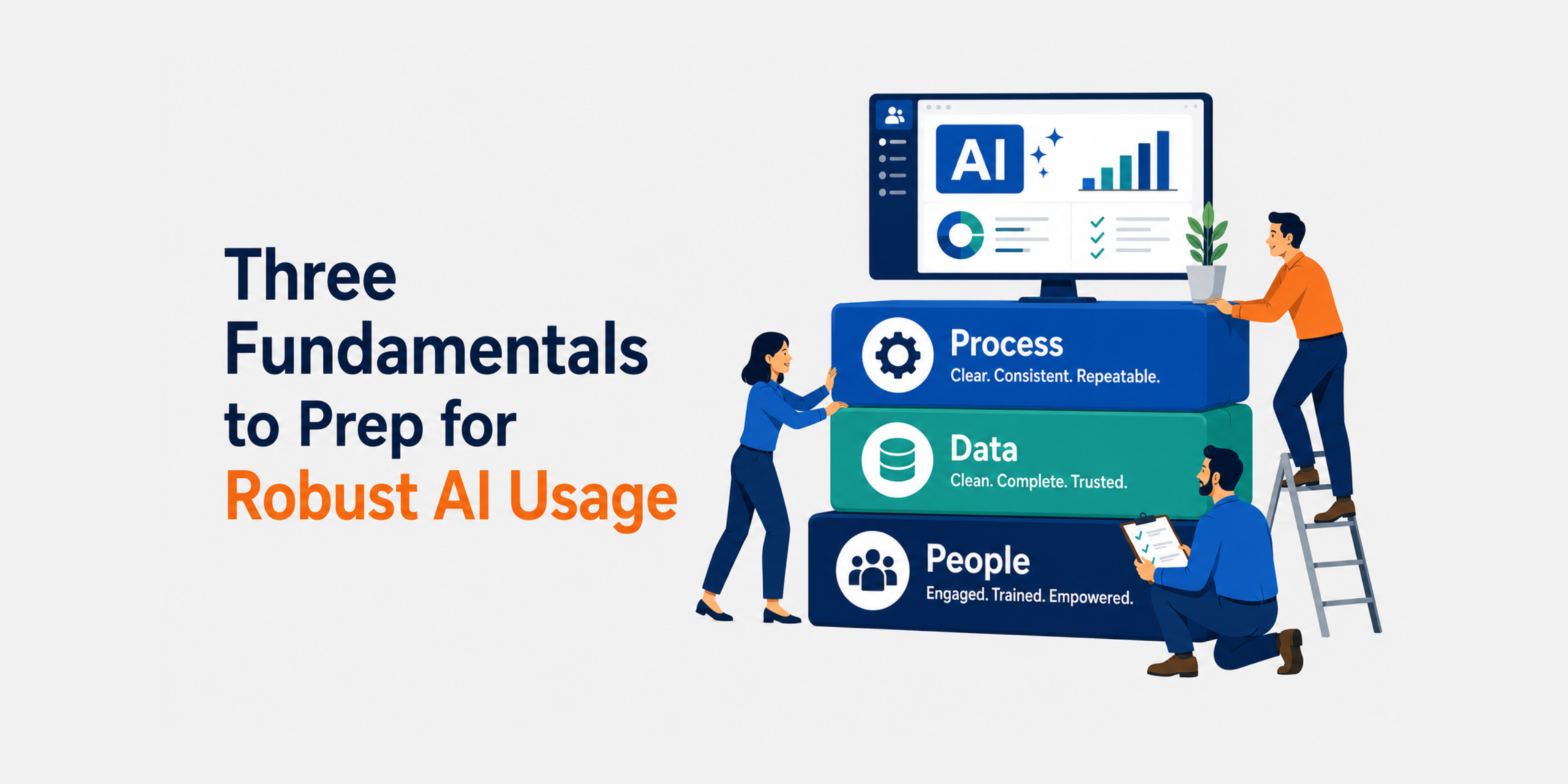
The use of artificial intelligence is exploding! In the Microsoft ecosystem alone, there are hundreds, if not thousands, of AI agents available for use. CoPilot can be found in each application within Microsoft 365, and every Dynamics 365 app has its own AI tools for consideration and use. Zoho and HubSpot also have a wide range of AI capabilities. It can be mind-boggling! Our clients often turn to us to ask how they should use these productivity tools.
Despite the prevalence of these tools, have you ever found yourself trying AI only to be disappointed? Maybe AI didn’t work as promised, or perhaps the results it provided were far less helpful than anticipated. Or have you used multiple iterations of an increasingly refined AI prompt, only to find that each successive answer was less helpful than the one before? If this sounds familiar, you are not alone! Many of us have had that experience.
When I attended DynamicsCon 2026 in Las Vegas, I was reminded of some basic principles that help CRM database users really leverage AI to its fullest. It’s not rocket science, but few of us have the discipline to do it. See if you agree.
Process
First, start with your processes.
-
-
- Are they clear and consistent?
- Have they been documented?
- Are there well-defined hand-offs between people and/or departments?
- Have all the key players been part of developing your processes?
- Can anyone follow your processes without guidance?
-
For example, before developing or using your CRM, your go-to-market (GTM) processes should be outlined and agreed upon. Sales, marketing, and customer success stakeholder teams should get into a room and discuss:
-
-
- What is a lead?
- Where do leads come from?
- What is the definition of a marketing-qualified lead? And what are the requirements to move from a lead to an MQL?
- What is the definition of a sales-qualified lead? And what does it take to move from an MQL to an SQL?
- When does an SQL become a sales opportunity?
- How do handoffs occur between teams?
- How do sales team members provide marketing with feedback on SQLs and won (or lost) deals?
- When and how does the customer success team engage?
- How does the customer success team give feedback to sales colleagues?
- What are the shared goals and metrics between sales, marketing, and customer success?
-
If you have a robust Revenue Operations (RevOps) strategy, you probably have this all figured out. However, if you don’t, then you might be leaving some things to chance or luck. If you don’t discuss and agree on this level of detail, you are at risk of gaps and/or redundancy in your processes. Multiple people may be doing the same tasks (and may be doing them differently), or, worse yet, team members may assume someone else is handling the job, so no one does. Things simply fall through the cracks. This becomes a case of hoping for the best and getting far less than planned. Disappointment and frustration rear their ugly heads.
Bottom line ... If we don’t have a clear process for finding and qualifying leads, what will an AI Sales Qualification Agent do? Make up its own process? Sorry, I’m jumping ahead!
Data
Next, you need to think about what data you need to ensure the processes you’ve agreed to can be tracked and measured. Remember, only capture the necessary data. If you try to capture too much data, it will be hard to maintain and will clutter your database.
Also, go back and look at your current data.
-
-
- Is it old and irrelevant? If so, get rid of it.
- Are there data gaps? If so, try to fill the gaps as best as possible. It may be challenging to go backwards, but with your new processes in mind, decide on what data is required going forward and stick with it.
- Are there duplicates? If so, either merge the duplicates or, if one or more duplicates are bad, just delete them.
- Is any of your data simply wrong? Then weed it out and eliminate it.
-
AI, when deployed, will use the data you have. It sounds trite, but it’s true what they say, “garbage in, garbage out”. In addition, missing data may cause AI to hallucinate and make up its own answers. In the world of AI, good data is extremely valuable. Don’t underestimate this company resource and protect it with all you’ve got!
People
The best laid plans are worthless unless executed as planned. Once you have agreed on your processes and your data needs, your people need to be trained to follow the processes and capture the data required. Getting your house in order is not a one-time event; it is ongoing and, unfortunately, never-ending. Your processes may evolve, but you don’t know if they are good unless you use them consistently. As you find better and more productive processes, you can adopt them. Just do it in a way that all key stakeholders have input and agree on what is changing.
I have found that configuring your CRM to support your processes is a great way to reinforce them. In addition, when sales and marketing leaders use their CRM views and dashboards to lead review meetings and highlight best practices (as well as identify gaps), it goes a LONG way to driving the behavior needed to get team members properly engaged with your processes as designed.
Similarly, your data needs may evolve over time but start with whatever you agreed upon. Reward behavior that captures complete and consistent data. Use your CRM to highlight missing data and to support those who gather and maintain good data.
This third fundamental involves change management and behavior modification, which can be challenging. I have found that consistently reminding users of “What’s in it for them?” helps to drive the desired change. In addition, when leaders practice what they preach and use the CRM themselves, they serve as role models. Team members who aspire for more responsibility will, more often than not, follow their leaders and mimic the behavior they see. Be the change you want to see!
AI
Finally, once your processes are clear, your data is in good shape, and your people are committed to keeping it that way, AI can be successfully introduced and can make a dramatic and positive difference. It is less likely you will try AI and fail because you have set yourself up for success. As a result, AI can increase your team’s productivity by augmenting some of the tasks they used to do. Then, experimenting with AI can be done with confidence because you know your fundamental building blocks are in place.
Making modifications to processes, data, and people shouldn’t take more than 90 days. With the right commitment and/or assistance, you should be able to put these in place within one full business quarter. Here at TopLine Results, we are happy to help you establish this success framework. We have helped many clients with their processes, their data, and their CRM adoption. We would be more than happy to help you! Just reach out by phone (262-691-1444) or email (info@toplineresults.com ), and we can discuss your needs and put an appropriate plan together. We want to ensure you have the fundamentals in place so you can use AI with confidence!
Side note: If you need help with a basic RevOps strategy, you might want to consider reading Ignite TopLine Growth: How RevOps and Go-To-Market Alignment Spark Success, a book our CEO wrote after a transformational experience at GE Healthcare. She can help you get started!