
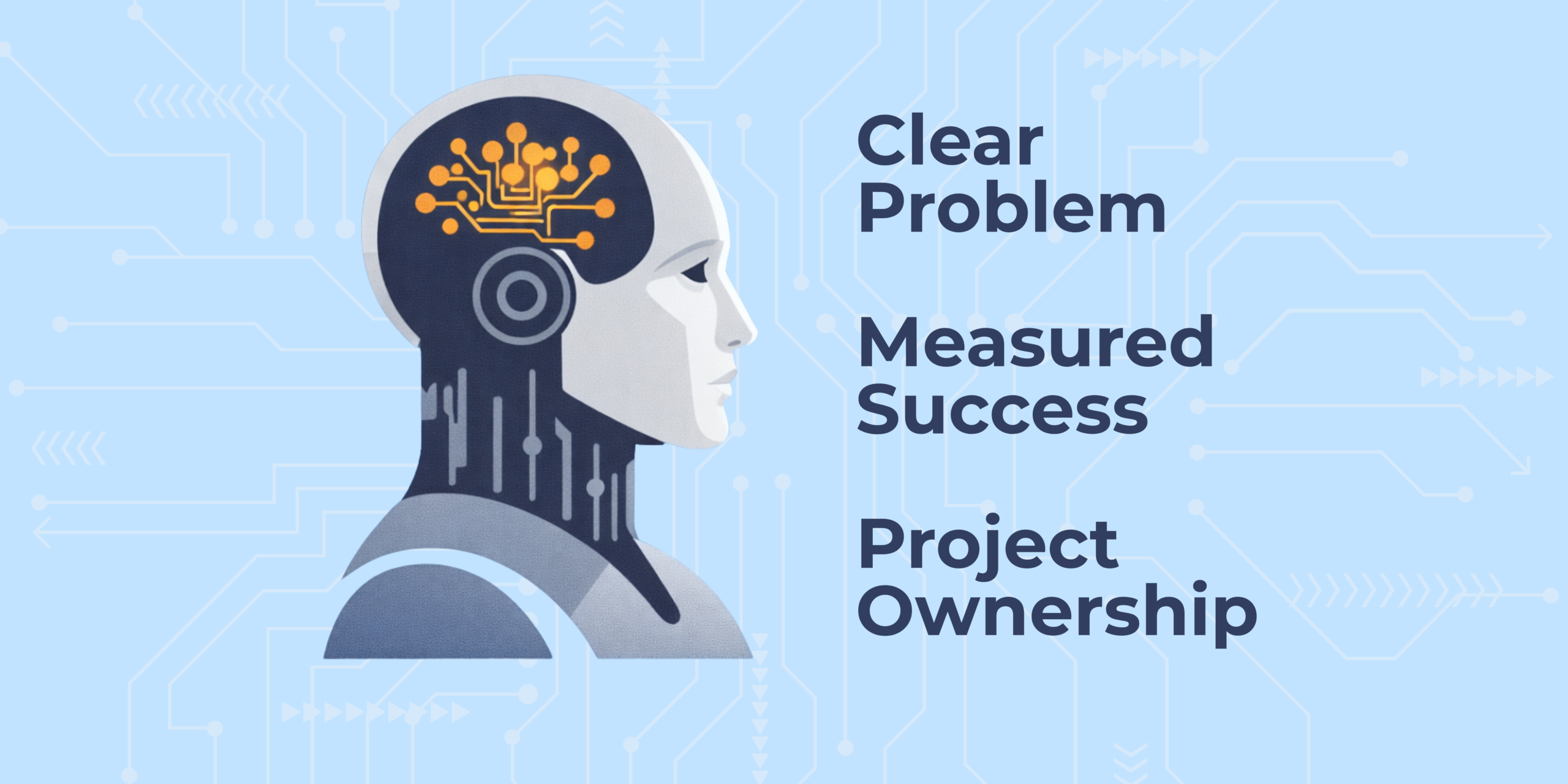
“The businesses that succeed with AI are not necessarily the most technical. They are the most clear. They know what problem they are solving, how success will be measured, and who is responsible for the outcome.”
Generative Artificial Intelligence offers real potential for businesses but realizing that potential is not guaranteed. Many AI initiatives stall or disappoint because organizations don’t have a clear understanding of what they are trying to achieve or how success should be measured.
AI conversations often jump straight to tools, features, and ambitious plans. But what’s frequently overlooked is the essential groundwork: defining a clear objective, mapping out the process, and assigning ownership for results. Without this upfront strategy, AI projects can easily go off track and fail to deliver what the business needs.
Successful AI efforts don’t start with complex models or technical depth. They start with clear thinking, disciplined preparation, and realistic expectations. In this blog, we’ll focus on the initial groundwork that business leaders must establish first, so that AI becomes a useful extension of the business, not an experiment searching for a purpose.
Start with a Clearly Defined Objective
The most important step in any AI initiative is defining the objective. Before discussing tools, vendors, or technical approaches, ask yourself, “What is the exact end result I want?”
Focus on the outcome, not the “how.” For example, instead of saying, “We want to use AI in customer service,” define the goal more clearly: “We want to reduce average response time to inbound customer emails by 50% while maintaining quality.”
Your objective should be written in a way that is fully and clearly understandable to anyone reading it. If the goal is vague or ambiguous, the end result will be vague as well. AI performs best when it is aimed at a clearly defined target.
In general, the best candidates for AI are high-volume, repeatable processes. These are tasks that follow similar patterns over and over again. The reason is simple: a single AI systems can execute the same process simultaneously and at scale, while a human team would need multiple people to achieve the same output.
On the other hand, avoid starting with areas where the consequences of failure are severe such as drafting legal documents, financial approvals, or medical advice. Early AI projects should build confidence, not introduce unnecessary risk.
If You Can’t Teach a Person, You Can’t Teach Generative AI
A helpful way to think about AI is to imagine it as an intern. It is capable, but it can't read your mind. It can only do what’s possible, teachable, and clearly explained. If a task can't be completed by a person today, using existing processes and available resources and documentation then it’s unlikely to succeed with AI.
To prepare for AI engagement, write out the process step-by-step as if you were going to hand it to someone who has never done the job before. Define inputs, actions, decisions, and outputs. Be as detailed as possible.
Then ask yourself: If I gave only these instructions to someone new, would they achieve the correct outcome?
If the answer is no, refine the instructions. Continue rewriting until the process is clear enough that another person could follow it successfully. Those instructions will form the foundation of any AI solution.
Collect Data and Resources
The instructions tell the AI agent what to do and how to do it, but without data and other resources, the AI agent typically doesn’t have enough information.
Just like an intern, AI needs the right information to do its job. If it lacks access to accurate data, it will either ask questions or make assumptions. When there is not enough information available, that is when AI systems can produce incorrect or “hallucinated” outputs.
Here are some examples for you to consider for data and resources:
-
-
- Historical records: Past customer emails, support tickets, invoices, claims, or work orders that show real world patterns that AI can learn from.
-
-
-
- Reference documents: Policies, SOPs, playbooks, pricing sheets, FAQs, or internal knowledge base articles that AI can consult when making decisions.
-
-
-
- Input templates: Standard forms, intake emails, request formats, or data schemas that define what “good input” looks like.
-
-
-
- Approved outputs: Examples of high-quality responses, reports, summaries, or decisions that represent the desired result.
-
-
-
- Negative examples: Samples of incorrect, incomplete, or unacceptable outputs that confuse boundaries and prevent poor reasoning.
-
Providing example resources is especially powerful. Showing both good and bad output helps define expectations and clarifies what success and failure look like. The clearer the inputs and examples, the more reliable the results are.
Define What Success Looks Like
AI projects should not be judged on excitement or novelty. They should be measured against business results.
Before starting, determine what success would look like. Time saved? Cost reduced? Errors minimized? Revenue increased?
Establish a baseline so that improvement can be measured. For example, if processing invoices currently takes 20 minutes each, that is your starting point. After implementation, you can objectively determine whether the AI solution created measurable value.
Without defined success criteria, it becomes difficult to know whether a project truly worked or was impactful.
Plan for Ownership and Ongoing Maintenance
AI is not a “set it and forget it” system. Models evolve, processes change, and business conditions shift. What works today may require adjustment tomorrow.
For this reason, every AI initiative needs an owner. This is a specific person responsible for ensuring the system continues to operate properly. That owner monitors performance, gathers feedback, and alerts engineers or consultants if changes are needed.
Additionally, budget for ongoing maintenance. Just as you maintain software, equipment, or infrastructure, AI systems require attention and refinement over time.
Clear ownership and maintenance planning prevents small issues from becoming major problems.
Putting AI Preparation into Practice
AI does not have to be mysterious or intimidating. At its core, it is a tool that executes clearly defined, repeatable tasks using the information and instructions you provide.
If you approach AI with:
-
-
- A clearly defined objective
-
-
-
- A documented step-by-step process
-
-
-
- Accessible, organized data
-
-
-
- Measurable success criteria
-
-
-
- A designated owner for ongoing oversight
-
then you will already be ahead.
“The businesses that succeed with AI are not necessarily the most technical. They are the most clear. They know what problem they are solving, how success will be measured, and who is responsible for the outcome.”
With the right preparation, AI becomes less about hype and more about disciplined execution, and that is where real business value is created.
If you need help on reviewing how AI can support your business needs, contact us by calling 1-800-880-1960 or email info@toplineresults.com.